

MAIN TECHNICAL ARTICLE
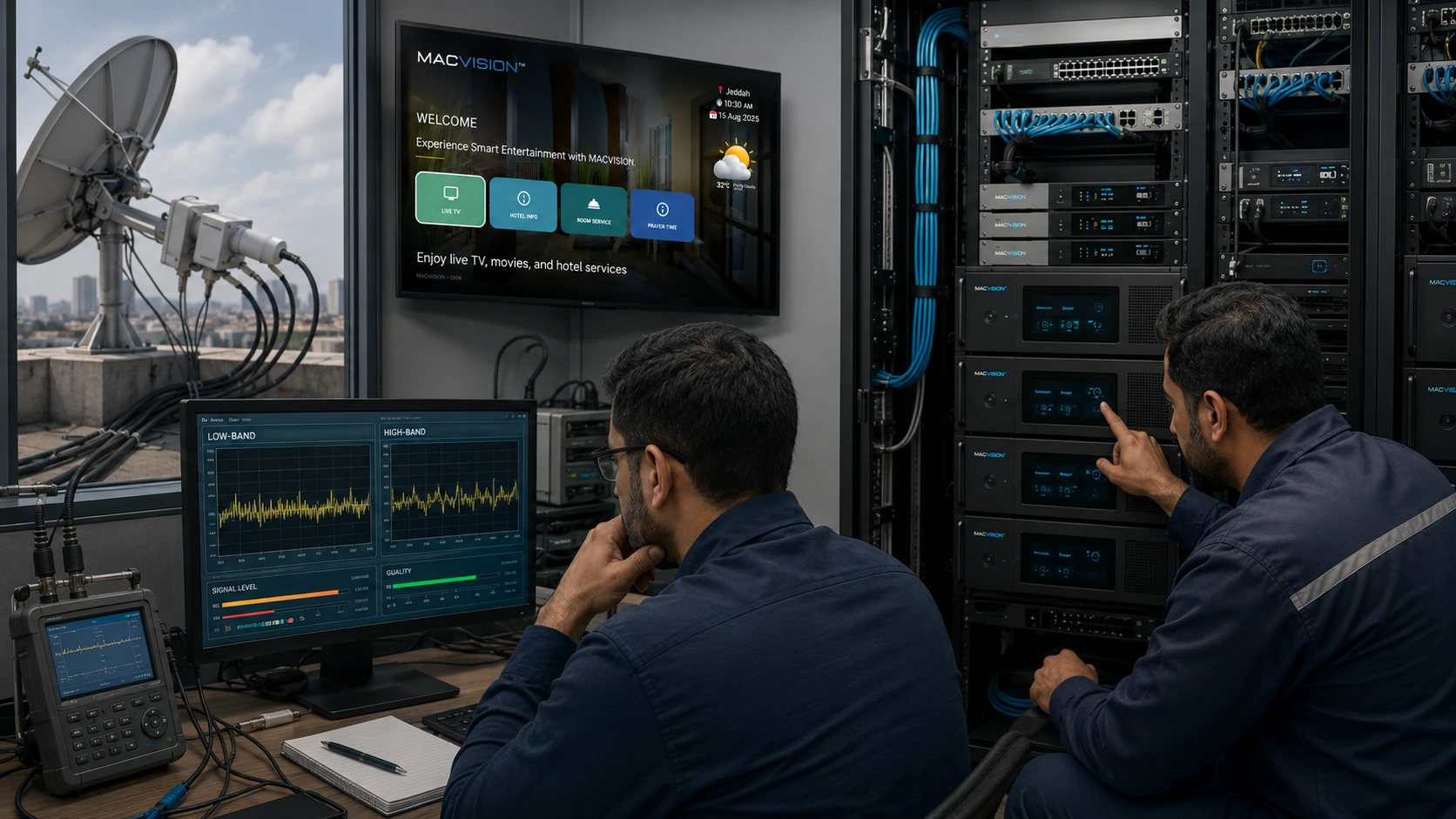
A universal LNB divides the satellite spectrum into low and high bands. The receiver normally selects the high band by sending a 22 kHz tone and uses different local-oscillator frequencies to convert the satellite carrier into the intermediate-frequency range. If the tone is missing, continuously present or distorted, one band can disappear or the tuner may calculate the wrong frequency. In multi-tuner IPTV headends, this problem can affect an entire group of channels while services in the other band remain normal.
Why do low-band channels work while high-band IPTV channels are missing?
Answer: The high band usually requires a 22 kHz control tone. If the tuner does not generate the tone, a power inserter filters it, a multiswitch does not detect it or the LNB high-band oscillator has failed, the LNB remains in low-band mode. The headend then searches the wrong intermediate frequency and cannot lock the requested high-band transponders. Check whether all failed services are above the band-switch frequency and verify tone presence with suitable test equipment or a known-good direct receiver.
Can an incorrect 22 kHz setting make channels appear on the wrong frequency?
Answer: Yes. The received intermediate frequency depends on which local oscillator is active. When the tuner assumes high-band conversion but the LNB remains in low band, or the reverse, the calculated tuning frequency is wrong. Some equipment may accidentally lock a different carrier, creating misleading channel lists or duplicated services. Confirm the LNB local-oscillator values and band-switch threshold in the tuner configuration, then compare the expected IF calculation with the measured spectrum before rescanning channels.
How should high-band and low-band switching be validated across an IPTV headend?
Answer: Select reference transponders from VL, VH, HL and HH quadrants. Verify that each tuner or multiswitch output can lock all four combinations with stable quality. Measure or monitor 13/18 V and 22 kHz commands while changing services. On a Quattro-LNB design, ensure each fixed quadrant feed is connected to the correct multiswitch input because the switch, not the LNB, handles selection. Document the tested frequencies and quality values so a later band-specific failure can be identified without repeating a full satellite scan.