

MAIN TECHNICAL ARTICLE
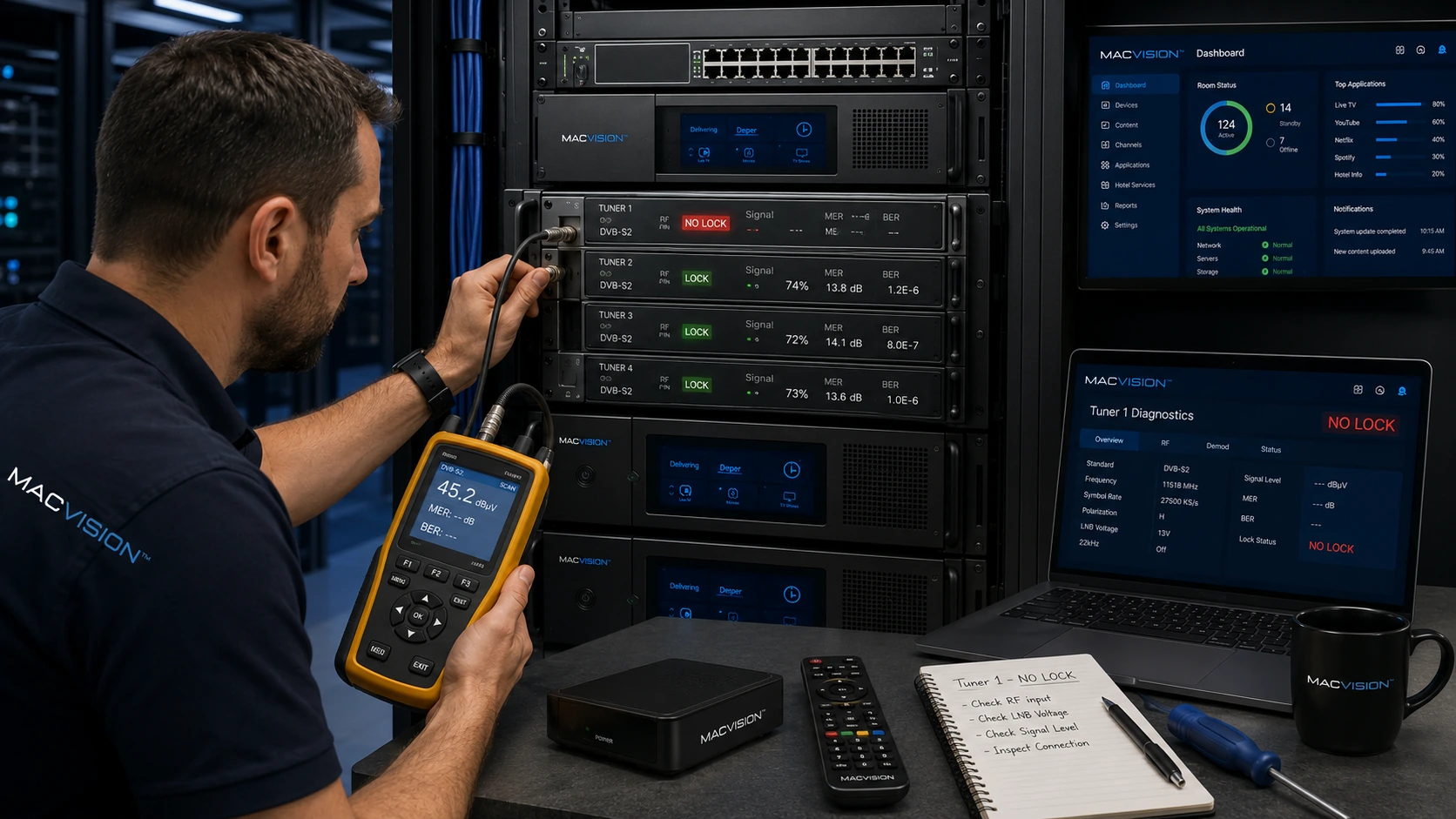
A tuner lock failure means the demodulator cannot acquire and maintain the requested carrier. The cause can be outside the headend—wrong satellite, poor signal, missing band or polarization—or inside it, such as incorrect parameters, tuner resource conflicts, firmware faults or excessive/insufficient input level. A structured test should confirm RF presence, parameter correctness and hardware operation before rescanning or replacing equipment.
What should be checked first when a headend tuner reports no lock?
Answer: Confirm the selected input and tune a known-good reference transponder on the same satellite, band and polarization. Verify frequency, symbol rate, polarity, modulation settings and LNB profile. Measure input level, MER and BER at the tuner connector. If the reference also fails, trace the RF path upstream. If the reference works, investigate the requested transponder parameters, encryption state or tuner capability. This sequence avoids changing dish alignment for a database error or changing software for an RF fault.
Why can a tuner repeatedly lock and unlock the same transponder?
Answer: The signal may be operating near threshold because of marginal MER, intermittent cable contact, LNB oscillator drift, weather, overload or an unstable power supply. A resource conflict or firmware issue can also reset the tuner. Monitor RF quality and lock logs over time and correlate events with temperature, weather and other tuner activity. If RF metrics remain stable while the module resets, inspect firmware and hardware; if metrics fluctuate before each unlock, follow the reception path.
How is a persistent no-lock condition resolved without changing downstream channels?
Answer: Repair the source while preserving the service output mapping. After correcting RF, parameters or tuner hardware, select the original service ID and route it to the existing encoder or multicast address. Verify all audio and subtitle PIDs and confirm continuity counters. Avoid deleting the channel from middleware unless the service itself has changed. This keeps room televisions, favorites and EPG mappings intact while the tuner source is restored.