

MAIN TECHNICAL ARTICLE
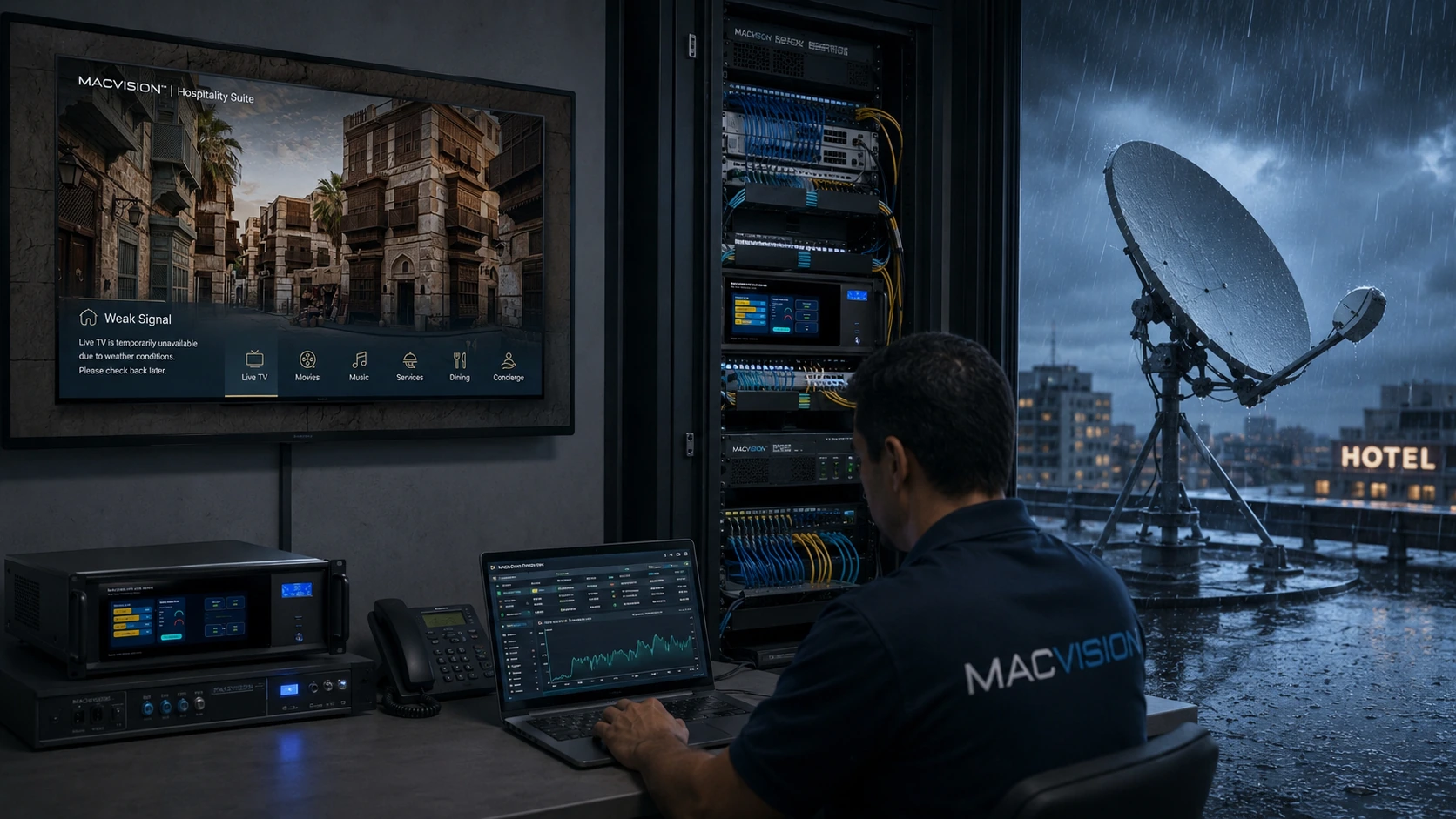
Rain, dense cloud, dust accumulation and water on the feed path attenuate satellite signals, particularly at higher frequencies. A correctly designed system includes enough fade margin to remain stable during normal local weather. Repeated IPTV failure during rain usually indicates marginal dish alignment, inadequate reflector size, poor connectors, water ingress or an already low-quality transponder. Weather does not damage the IP network itself, but RF errors entering the headend propagate to every TV receiving the affected channel.
Why do IPTV channels freeze only during rain or heavy dust?
Answer: Precipitation and airborne particles reduce the received carrier level and can increase depolarization. If the normal-weather MER or C/N is already close to the tuner threshold, the additional loss produces uncorrectable errors. The first failures normally occur on weaker transponders or higher-frequency services. Because all endpoints use the same headend source, many rooms see the same breakup simultaneously. The correct remedy is to improve the RF link margin, not to increase middleware buffer values or reboot televisions.
How can a technician determine whether weather failure is caused by dish size or poor alignment?
Answer: Record clear-weather quality on the weakest required transponders and compare it with expected values for the satellite footprint and reflector size. Re-peak azimuth, elevation and skew; a significant improvement indicates alignment was the main issue. Inspect the reflector for deformation and the line of sight for partial obstruction. If alignment is optimal but the measured margin remains inadequate, a larger dish or higher-quality feed system is required. Cable loss and water ingress must be eliminated before changing the reflector.
What preventive measures reduce rain-related IPTV outages?
Answer: Use an appropriately sized dish, rigid mount and weather-sealed connectors. Maintain a clean reflector and feed cover, route coax with drip loops and replace cables showing moisture or corrosion. Optimize skew and alignment using the weakest transponders, then document normal MER and BER. Configure monitoring to alarm before lock is lost, allowing maintenance teams to identify gradual degradation. Diversity reception or alternate channel sources can be considered for critical services, but they should complement rather than replace a properly engineered primary satellite link.