

MAIN TECHNICAL ARTICLE
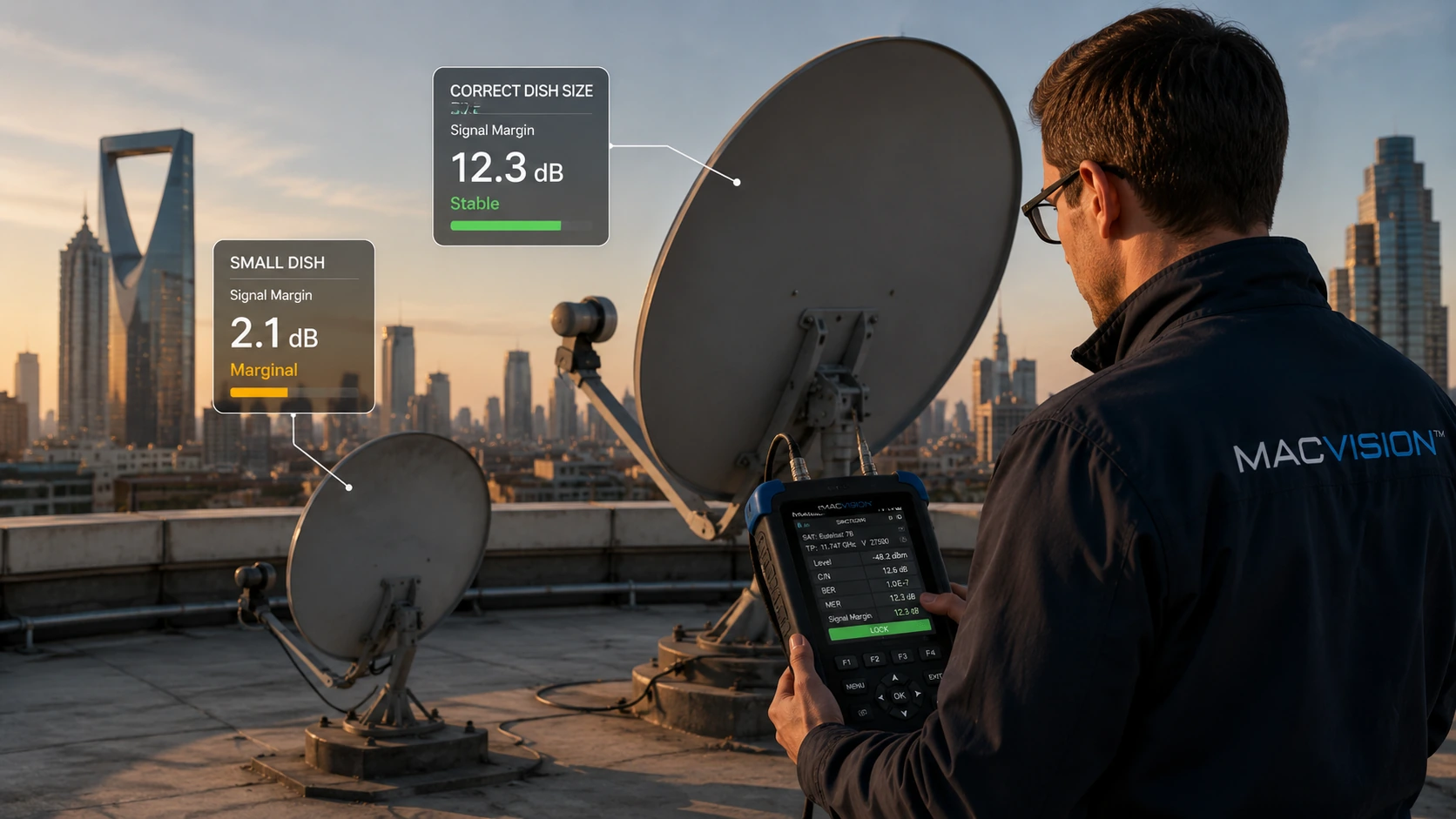
Reflector size determines antenna gain, beamwidth and the available fade margin. A dish that is adequate for a home receiver may be unsuitable for a hotel headend expected to deliver uninterrupted service to hundreds of rooms. Satellite footprint, local climate, frequency band, required transponders, adjacent-satellite spacing and installation tolerance must all be considered. Undersized dishes typically produce recurring weather outages and weak-transponder failures, while an unnecessarily large dish increases structural and wind-loading requirements.
How does an undersized satellite dish affect IPTV channel reliability?
Answer: A smaller reflector collects less signal energy and generally has a wider beamwidth. The lower gain reduces C/N and weather margin, while the wider beam can admit more energy from adjacent satellites. Strong transponders may remain usable, but weaker carriers suffer elevated BER and fail during rain or dust. In an IPTV system the impact is multiplied because one marginal source feeds every television. Dish size should therefore be selected for the weakest required transponder and local fade conditions, not only for initial lock on a clear day.
What information is needed before choosing a dish for a hospitality IPTV headend?
Answer: Identify the satellite footprint or EIRP at the site, frequency band, required transponders, modulation modes and target availability. Consider local rainfall, dust, wind, mounting height, line of sight and adjacent-satellite separation. Include losses from the feed, cable and distribution system. The selected dish should provide quality margin after these losses and should be mechanically suitable for the location. A site survey and measured trial are valuable when the project lies near a footprint edge or serves mission-critical channels.
Can a larger dish solve every weak-signal IPTV problem?
Answer: No. A larger reflector cannot correct a wrong satellite, damaged LNB, incorrect skew, waterlogged cable, excessive amplifier noise or bad transponder parameters. It can improve gain and discrimination when the existing system is genuinely link-margin limited. Before replacement, verify alignment, feed position, polarization isolation, cable loss and tuner input level. If a larger dish is justified, upgrade the mount and wind-loading design as well; otherwise mechanical movement can remove the theoretical gain during adverse weather.