

MAIN TECHNICAL ARTICLE
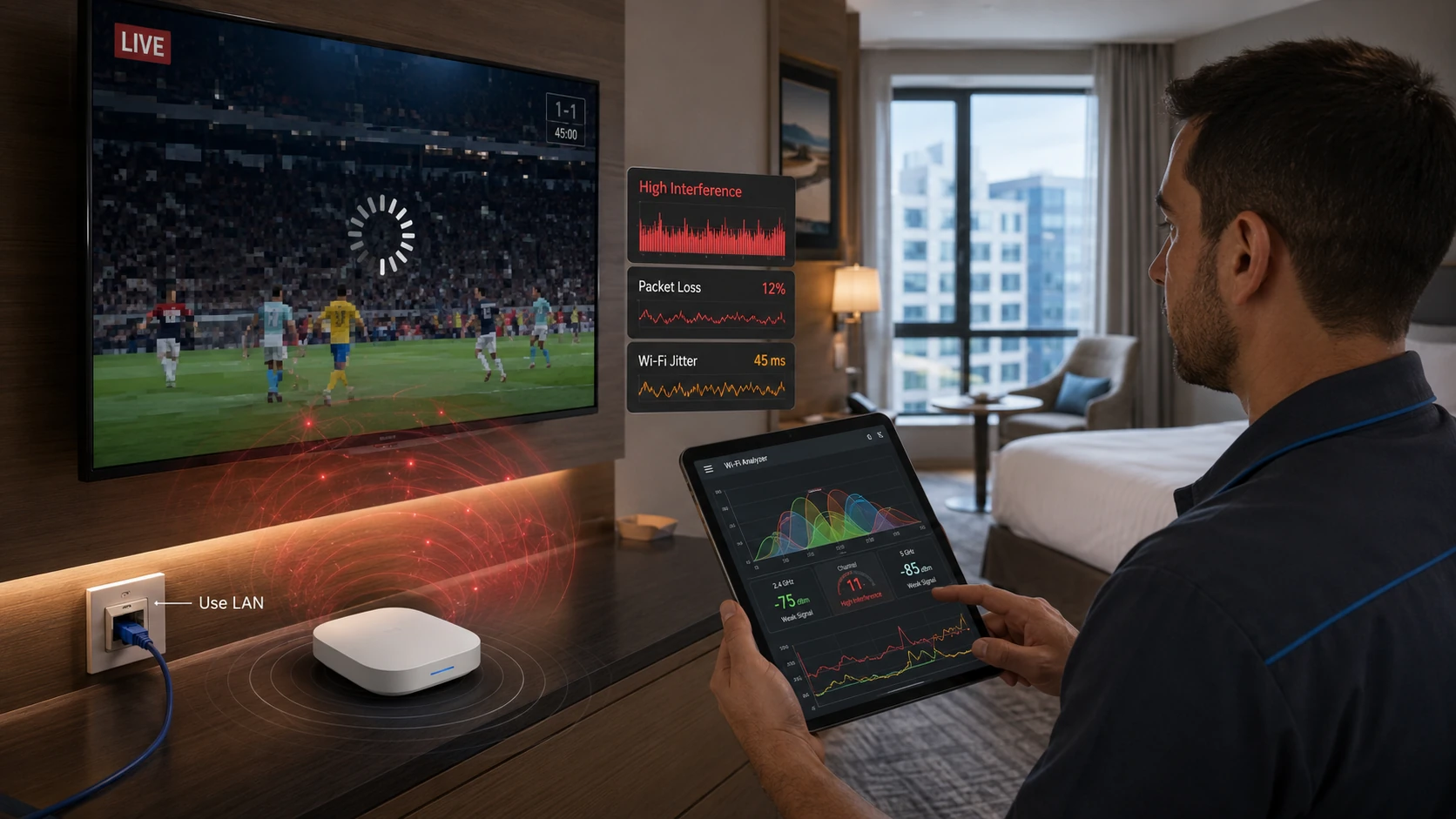
Wi-Fi is a shared, variable radio medium affected by interference, distance, client count, roaming and retransmissions. Multicast frames may be sent at low basic rates and are often not acknowledged, while unicast video competes for airtime with all other clients. Although carefully engineered wireless IPTV can work, fixed hospitality televisions should normally use wired Ethernet when live-channel reliability is a requirement.
Why does an IPTV channel freeze on Wi-Fi even when an internet speed test is fast?
Answer: A speed test measures short unicast throughput to one server and can use retransmissions. Live IPTV needs continuous low-loss delivery. Interference, rate changes and contention can create brief gaps that the average speed result hides. Multicast may also use a low data rate with no per-frame acknowledgment. Measure packet loss, jitter, signal quality and airtime utilization while the channel plays, not only internet bandwidth.
Can multicast IPTV be delivered efficiently over enterprise Wi-Fi?
Answer: It can be engineered using multicast-to-unicast conversion, suitable basic rates, controlled group membership and adequate access-point capacity. However, each converted stream consumes unicast airtime per client, and roaming behavior must be tested. Separate the design from guest Wi-Fi assumptions and validate the exact TV or STB radios. Critical fixed endpoints remain more predictable on cable.
What is the recommended fallback when cable cannot be pulled to a television?
Answer: Assess whether an existing certified cable path, fiber media converter, MoCA-like approved medium or local wired bridge is possible before choosing Wi-Fi. If wireless is unavoidable, perform a site survey, dedicate sufficient spectrum and capacity, use managed access points and test peak occupancy. Provide local buffering or lower-bitrate profiles where appropriate, but state the availability limitation clearly in the project design.