

MAIN TECHNICAL ARTICLE
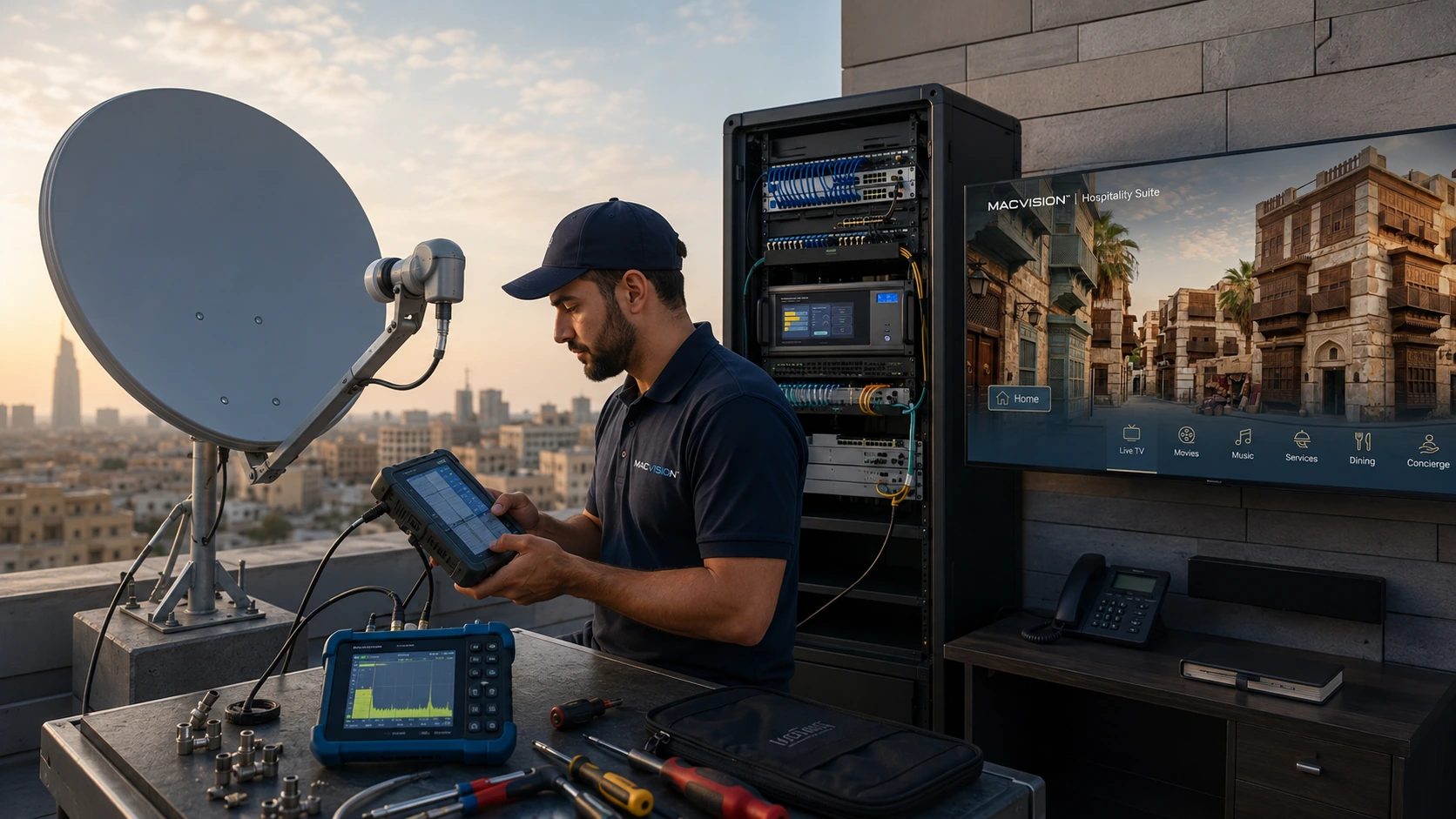
Dish alignment determines the margin available to every transponder used by the IPTV headend. A small azimuth or elevation error may still allow stronger services to lock, but weaker transponders can operate close to the receiver threshold. The result is a system that appears normal in clear weather and then develops mosaic blocks, audio gaps, frozen frames or complete channel loss when rain, dust or temperature changes reduce the link margin. Alignment should therefore be optimized using the weakest required transponder and quality measurements, not only the strongest signal displayed by a basic finder.
Can a slightly misaligned satellite dish cause intermittent IPTV freezing?
Answer: Yes. Digital reception has a cliff effect: the picture may remain perfect while quality is above the demodulator threshold, then fail quickly once the margin drops. A slightly misaligned dish reduces that margin. Strong transponders continue to work, while weaker ones begin producing uncorrectable errors during rain, wind movement or thermal expansion. Because the IPTV encoder simply repackages the incoming transport stream, those RF errors appear downstream as pixelation, short freezes, audio loss or black screen events on multiple televisions at the same time.
Why do only certain IPTV channels fail when the dish is not aligned correctly?
Answer: Channels are carried on different transponders with different power, polarization, modulation and coding parameters. A misaligned reflector does not reduce every carrier equally. Transponders near the edge of the satellite footprint, on the opposite polarization or using a less tolerant modulation mode may fail first. Group the affected channels by transponder frequency and polarity. If several failed services share one transponder or one polarization, the pattern strongly indicates an RF alignment, skew or distribution problem rather than a middleware or TV issue.
What is the correct procedure for aligning a dish used by an IPTV headend?
Answer: Confirm the mounting pole is plumb and the reflector is not distorted. Select a known transponder from the intended satellite, set the correct LNB type and move azimuth and elevation in small steps while watching MER or C/N. Optimize LNB skew after the dish peaks, then recheck elevation and azimuth because the adjustments interact. Finally test the weakest high-band and low-band transponders on both polarizations. Tighten all hardware without allowing the dish to move and document final quality values for future maintenance comparison.