

MAIN TECHNICAL ARTICLE
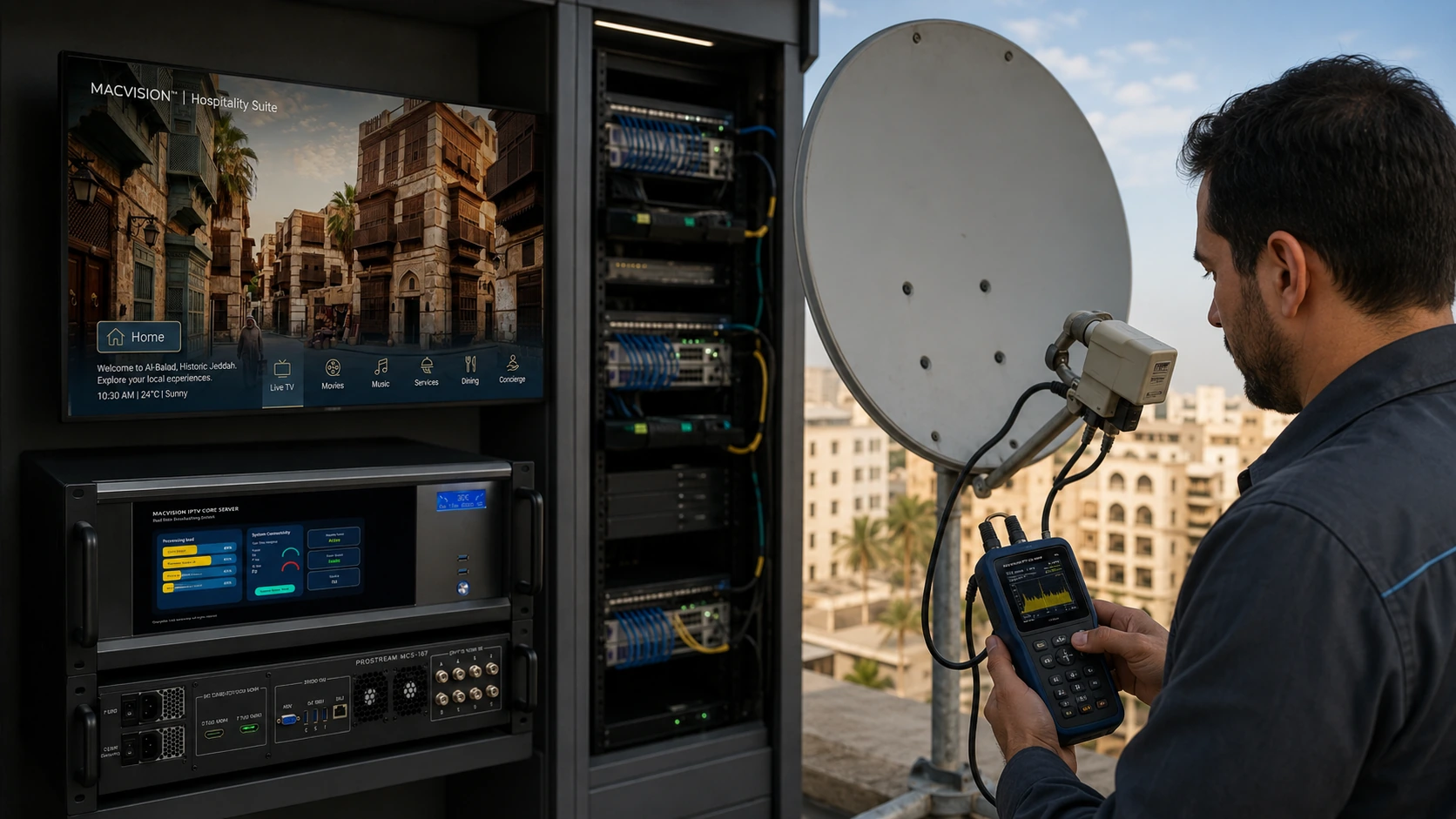
LNB skew is the rotational position of the feed relative to the satellite polarization. Incorrect skew reduces separation between vertical and horizontal carriers, allowing energy from the opposite polarization to interfere with the wanted signal. The effect may be limited to selected transponders or may become severe during weather changes. In an IPTV headend, cross-polarization degradation is commonly misdiagnosed as encoder instability because the downstream symptom is channel breakup. Proper skew adjustment is a quality optimization task and must be performed with MER, C/N or cross-polarization measurements.
How does incorrect LNB rotation affect vertical and horizontal IPTV channels?
Answer: When the LNB probe is not aligned with the received polarization, the wanted carrier level falls and the opposite-polarized carrier leaks into the tuner. This reduces the usable signal-to-noise ratio even when overall RF strength remains high. Some vertical services may become unstable while horizontal services appear normal, or the reverse, depending on the local interference environment and transponder powers. In severe cases, both polarizations lock but produce elevated BER, causing repeated pixelation and short channel freezes at every IPTV endpoint.
How can an installer confirm that LNB skew is the cause of channel errors?
Answer: List the affected channels and map them to transponder polarity. Measure a representative vertical and horizontal transponder directly at the dish. Slowly rotate the LNB in small increments and observe MER or C/N rather than the strength bar. If quality improves on the affected polarity and the opposite-polarized interference decreases, skew was contributing to the fault. Recheck all four universal-LNB quadrants after adjustment, because an apparent improvement on one carrier must not create a new loss on another required carrier.
What is the best method for setting LNB skew on a hotel IPTV dish?
Answer: Use the calculated skew for the installation coordinates only as a starting value. With the dish already peaked, select stable reference transponders on both polarizations and rotate the LNB for the best combined quality and lowest BER. Lock the feed clamp without twisting the cable or changing the position. Where a professional spectrum analyzer is available, compare the wanted carrier against the opposite-polarized carrier to maximize isolation. Record the final physical position and measured values so that future technicians do not reset it using an approximate visual angle.