

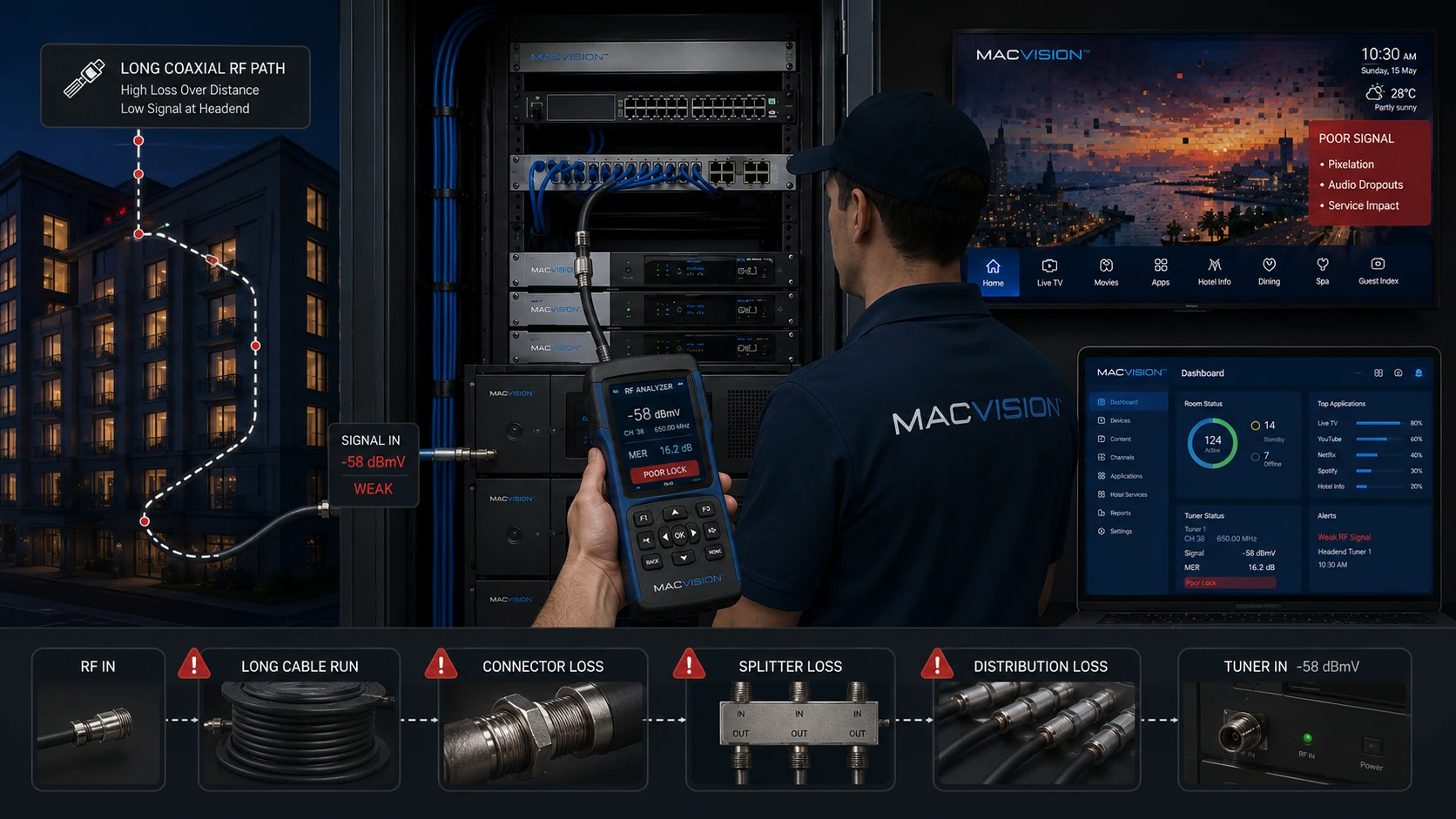
MAIN TECHNICAL ARTICLE
Insufficient RF level reduces the signal-to-noise margin at the tuner and can prevent reliable demodulation. Causes include long coaxial runs, excessive splitter loss, poor connectors, damaged cable, weak LNB output, an unpowered multiswitch or incorrect amplifier design. Low level may affect the highest intermediate frequencies first because coaxial loss increases with frequency. The repair must restore both level and quality; amplification after a noisy or corrupted point does not recover lost information.
What symptoms indicate that the satellite input level is below the tuner range?
Answer: Channels may take longer to lock, break up during weather changes or disappear on the highest-frequency transponders. Different tuners can fail at different times because their sensitivities vary. A direct feed near the dish may work while the headend feed does not. Measure actual level and quality at the tuner input and compare them with the manufacturer range. If level is low but MER remains good, distribution loss is likely; if both are poor at the dish, investigate alignment, LNB or obstruction first.
Why does adding an amplifier not always fix weak IPTV satellite channels?
Answer: An amplifier increases both the wanted signal and the noise already present. If the signal has poor MER or uncorrectable errors before amplification, those defects remain. A poorly chosen amplifier can also overload on strong transponders while still failing to correct cable tilt. The best location is normally before major distribution loss, with gain and output capacity calculated for the complete spectrum. Test direct reception quality first, then design amplification to compensate known losses rather than using gain as a general troubleshooting step.
How should low RF level be corrected across multiple headend tuners?
Answer: Calculate cable, splitter, tap and multiswitch losses from the LNB to each tuner. Repair connectors and replace damaged or unsuitable coax. Restore power to active equipment and balance outputs so short and long paths stay within range. If amplification is required, choose a low-noise unit with enough output headroom and equalization for high-frequency loss. Measure the weakest and strongest transponders at every representative input, then verify MER and BER under normal loading before accepting the repair.