

MAIN TECHNICAL ARTICLE
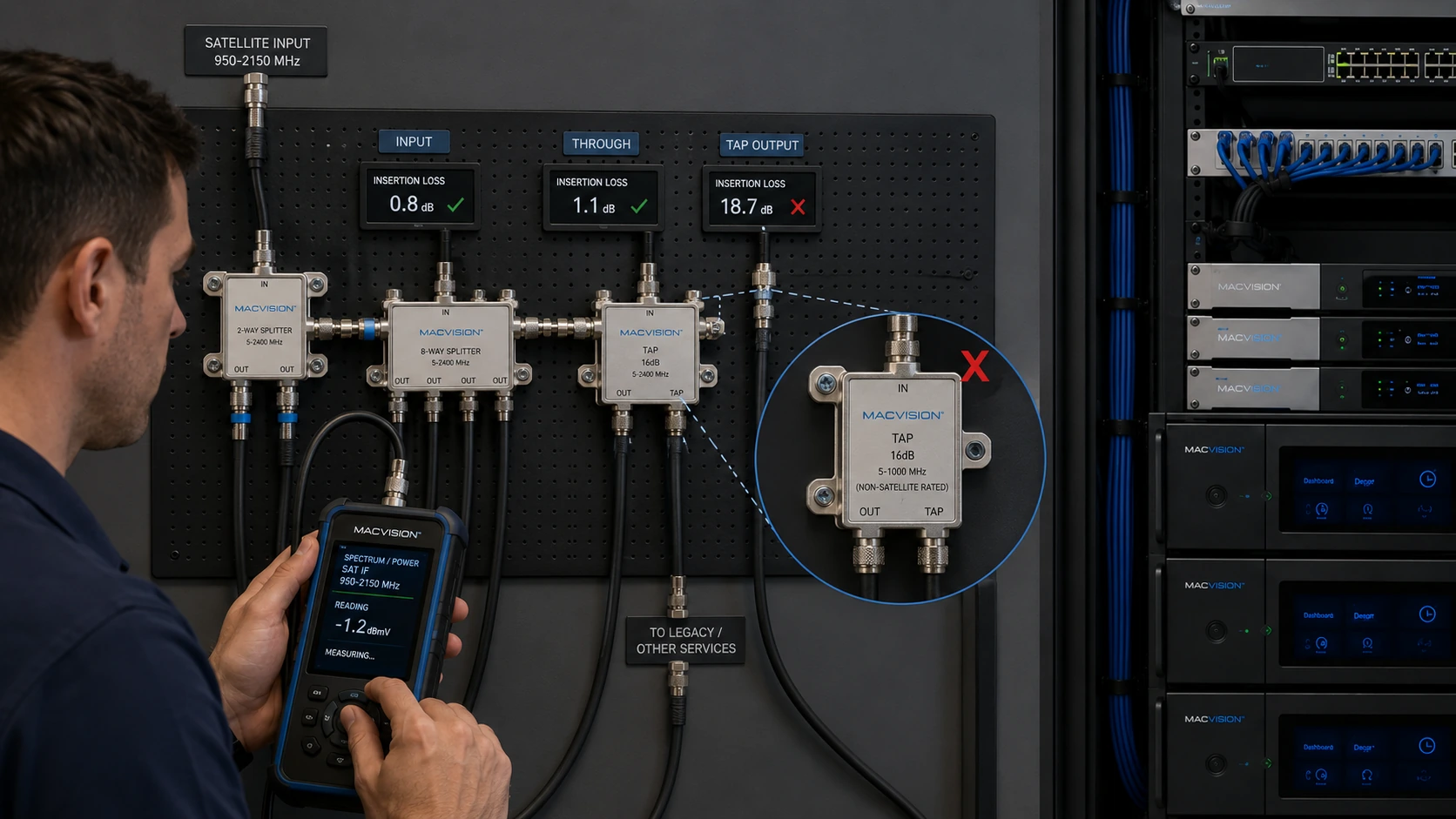
Satellite IF distribution cannot be treated like ordinary passive television splitting. Devices must support the full frequency range, DC power path and control-tone requirements. Every splitter introduces insertion loss, while poor isolation allows tuners to interfere with each other. Taps create different through and branch losses that must be included in the level plan. An incorrect component can block LNB voltage, remove 22 kHz control or attenuate high-band carriers enough to destabilize channels.
Why can an ordinary TV splitter remove satellite channels from an IPTV tuner?
Answer: Many terrestrial splitters do not pass the full satellite IF range and may block DC or the 22 kHz tone. Even a wideband splitter can be unsuitable if its power-pass direction conflicts with the design. Two tuners sharing a switchable LNB output can also send different voltage and tone commands, creating control conflicts. Use satellite-rated components with defined frequency response, isolation and DC behavior, and never split a switchable feed unless the architecture is specifically designed for it.
How do splitter insertion loss and tap values affect channel quality?
Answer: Each passive device reduces signal level, and the loss may rise at higher frequencies. A tap intentionally sends less power to its branch than to the through path. If these losses are not calculated, the final tuner can fall below its operating range even though upstream measurements look acceptable. Measure at the actual endpoint and compare high- and low-frequency transponders. Good system design balances levels so no tuner is weak and no short branch is overloaded.
What checks should be performed when replacing splitters or taps in a live headend?
Answer: Verify frequency range, insertion loss, isolation, return loss, DC-pass ports and current rating. Confirm whether the network carries fixed Quattro quadrants or receiver-controlled feeds. Label the power-pass direction before installation and terminate unused ports as specified. After replacement, test representative transponders from all required bands and polarizations at the affected tuners. Recheck LNB current and multiswitch operation because a component that passes RF correctly can still interrupt control voltage or tone.