

MAIN TECHNICAL ARTICLE
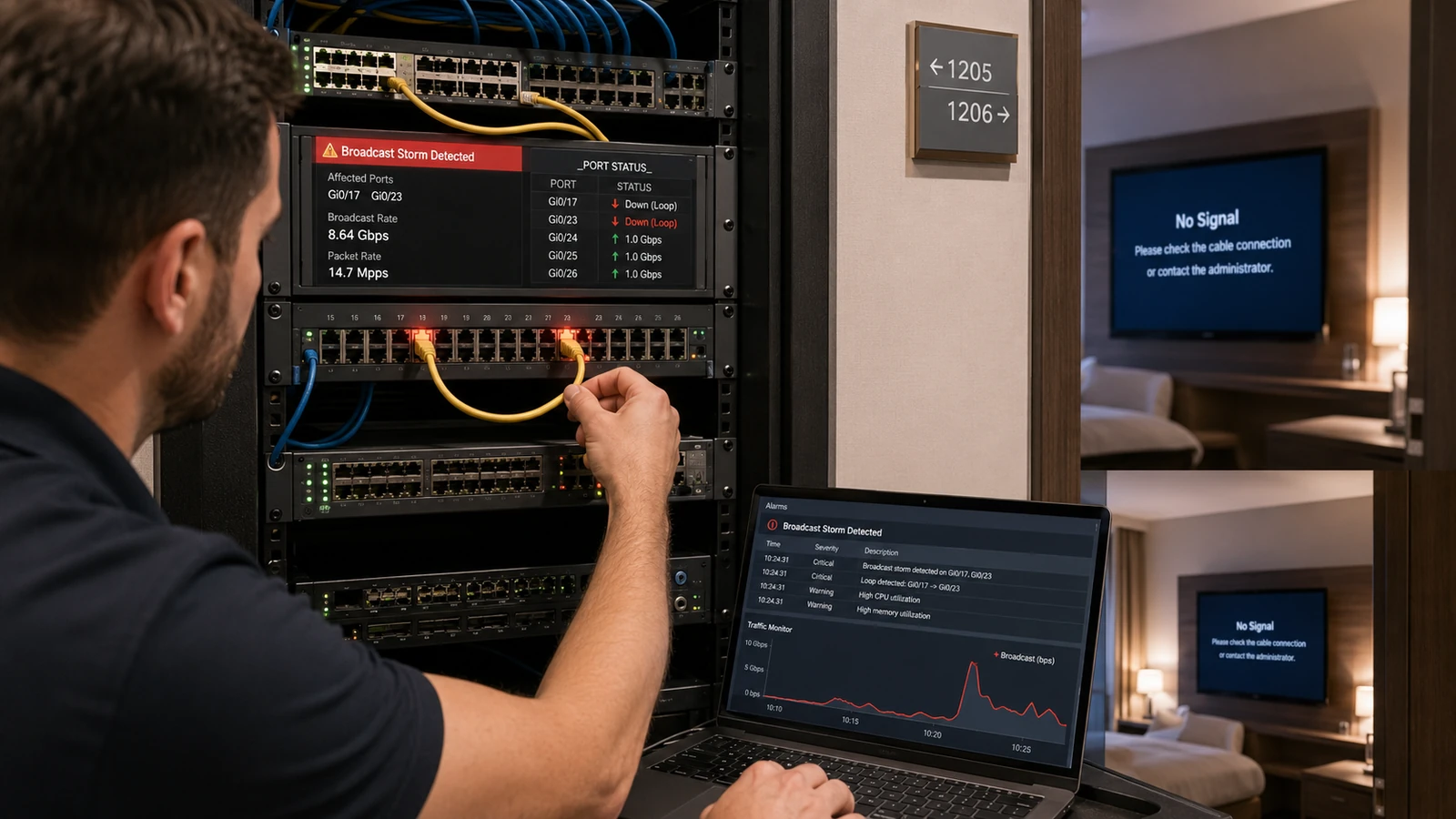
An Ethernet loop can multiply broadcast, unknown-unicast and multicast traffic until links and switch processors are saturated. IPTV often becomes one of the first visible casualties because packet timing and loss deteriorate rapidly. The same loop can disrupt DHCP, middleware access and other hotel systems. Spanning Tree, loop protection and disciplined patching are essential, especially in racks where redundant cables may be connected without a designed aggregation protocol.
How does a network loop appear to IPTV users?
Answer: Many channels freeze or fail at once, televisions lose network connectivity, middleware pages time out and service may recover briefly when a cable is removed or a switch reboots. Switch port LEDs can remain continuously active and CPU utilization rises. Interface counters show rapidly increasing broadcast or multicast traffic. The symptom is wider than a normal headend fault because control and unrelated network services are also affected.
How can the loop location be found safely?
Answer: Check topology changes, MAC address flapping and Spanning Tree events on managed switches. Identify ports with unusually high traffic or repeated source MAC movement. Disable suspect edge ports one at a time according to an incident plan, starting with recent changes or unmanaged switches. Do not randomly disconnect core links in a live property. Preserve redundant paths only when they use STP, link aggregation or another intentional loop-free design.
What configuration prevents loops from taking down IPTV?
Answer: Enable an appropriate Spanning Tree mode, define core root priorities and use edge-port protections such as BPDU guard and loop detection. Configure link aggregation correctly at both ends and avoid unmanaged bridging in guest rooms. Document patching and label redundant links. Monitor topology changes and storm-control events, but set thresholds carefully so legitimate IPTV multicast is not mistaken for a storm. Test failover paths during commissioning.