

MAIN TECHNICAL ARTICLE
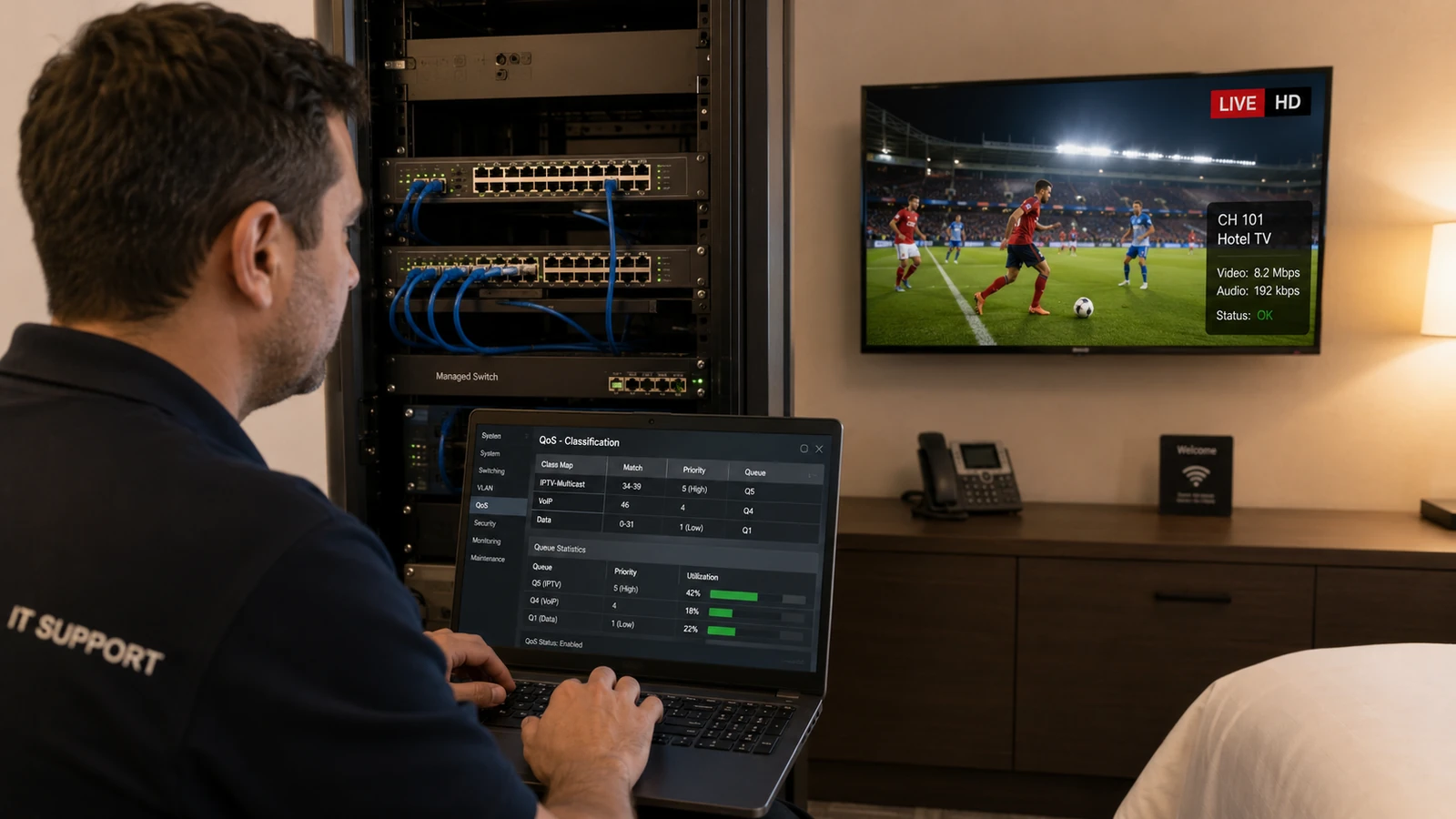
Quality of Service can protect live video when links carry mixed traffic, but incorrect classification or queue design can harm IPTV. Marking every packet as highest priority causes contention within the priority queue, while policing video below its real peak bitrate creates drops. QoS should be based on measured traffic, trusted boundaries and link capacity; it cannot compensate for a fundamentally undersized network.
Does IPTV always need highest-priority QoS on a local hotel network?
Answer: Not necessarily. A correctly sized, uncongested switched LAN can carry multicast without special prioritization. QoS becomes valuable on shared or constrained links where voice, video and data compete. Give IPTV an appropriate assured class rather than unlimited strict priority, especially when dozens of channels cross an uplink. Measure congestion points and queue behavior before assigning markings.
Why can a QoS policer cause regular IPTV pixelation?
Answer: If the policer rate is set near the average bitrate, normal variable-bitrate peaks exceed the limit and packets are discarded. The resulting loss can occur during complex scenes at repeatable times. Review drop counters and compare the configured committed rate with measured peak plus protocol overhead. Use shaping or a suitable burst allowance where appropriate, and avoid per-stream limits that ignore encoder variability.
How should IPTV QoS be validated after configuration?
Answer: Generate realistic peak traffic from IPTV and other services, then monitor queue utilization, latency and drops on every constrained link. Confirm markings are retained only from trusted sources and that endpoint or guest devices cannot claim the same priority. Test channel quality while file transfers, backups and voice calls are active. A successful policy protects video without starving control, voice or critical hotel applications.