

MAIN TECHNICAL ARTICLE
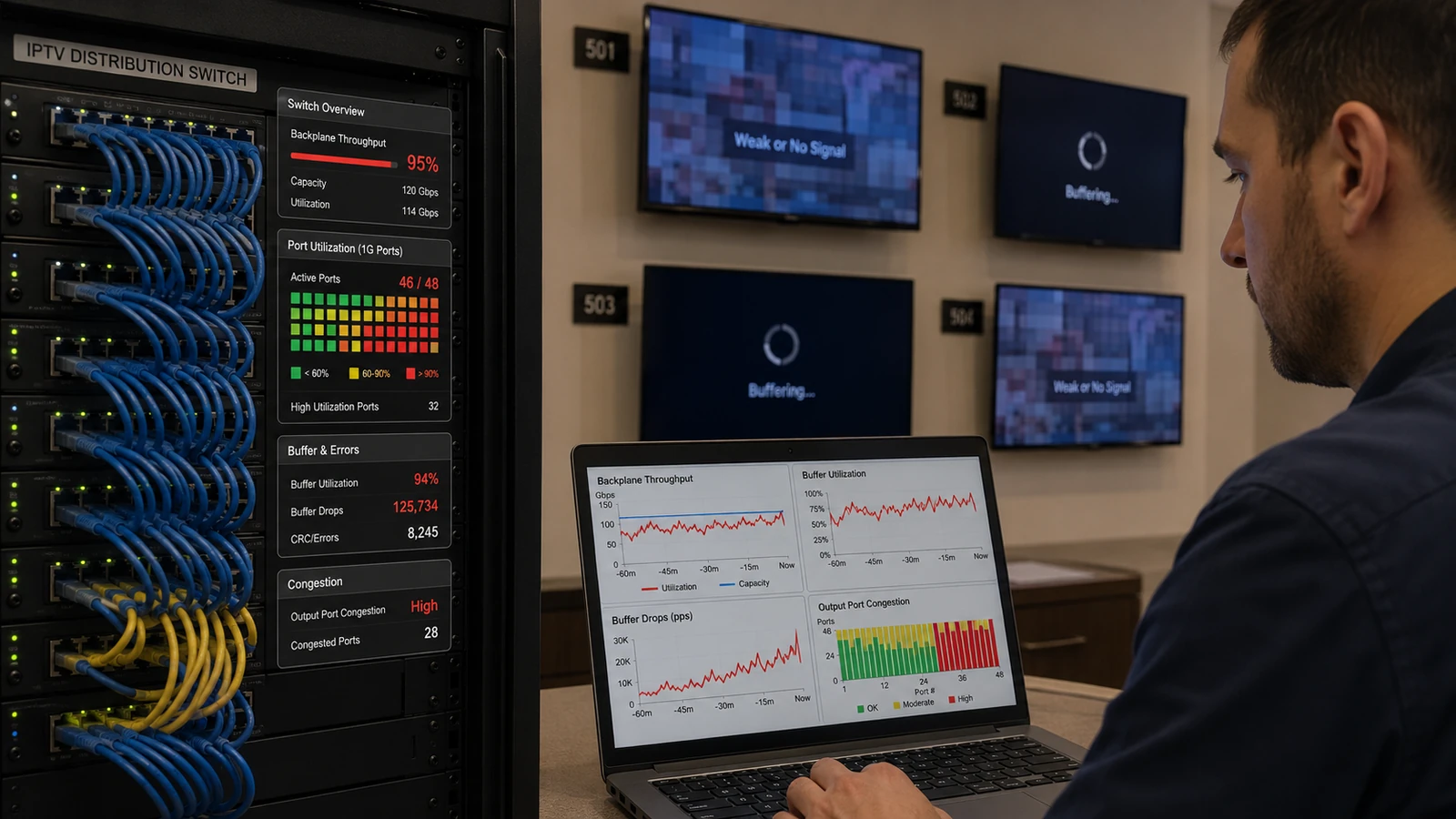
Port speed alone does not describe a switch's ability to carry many IPTV streams. The switching fabric, packet-forwarding rate, egress buffer and multicast replication architecture determine whether traffic can be forwarded without drops. A low-cost switch may have gigabit ports but perform poorly when many multicast groups are copied to several outputs or when traffic enters a faster uplink and exits multiple slower ports.
Why can a gigabit switch drop IPTV packets below one gigabit of total traffic?
Answer: Microbursts can fill small buffers even when average throughput is low. Multicast replication may consume internal resources, and oversubscribed switching fabrics can block simultaneous port activity. Packets destined for a 100 Mbps TV port can queue behind bursts from a 1 Gbps uplink. Review per-port egress drops and the switch's forwarding and buffer specifications rather than relying on nominal port speed.
What switch specifications matter most for a large IPTV deployment?
Answer: Consider non-blocking switching capacity, packet-forwarding rate at small packet sizes, multicast group and entry limits, IGMP snooping behavior, buffer architecture, uplink options, VLAN scale and management visibility. Power and environmental reliability also matter in hospitality closets. Validate with the planned number of channels and receivers because datasheet maximums may assume traffic patterns unlike real multicast replication.
How can switch-capacity limitations be corrected without replacing every access switch?
Answer: Identify the actual bottleneck. Upgrade oversubscribed aggregation links, move high-channel-count replication closer to access, reduce unnecessary flooded traffic and segment receiver groups. Replace only switches that show drops, insufficient multicast tables or unsupported control features. Where TVs use 100 Mbps ports, ensure they receive only the selected stream. Re-test at peak simultaneous usage and maintain capacity margin for future channels.