

MAIN TECHNICAL ARTICLE
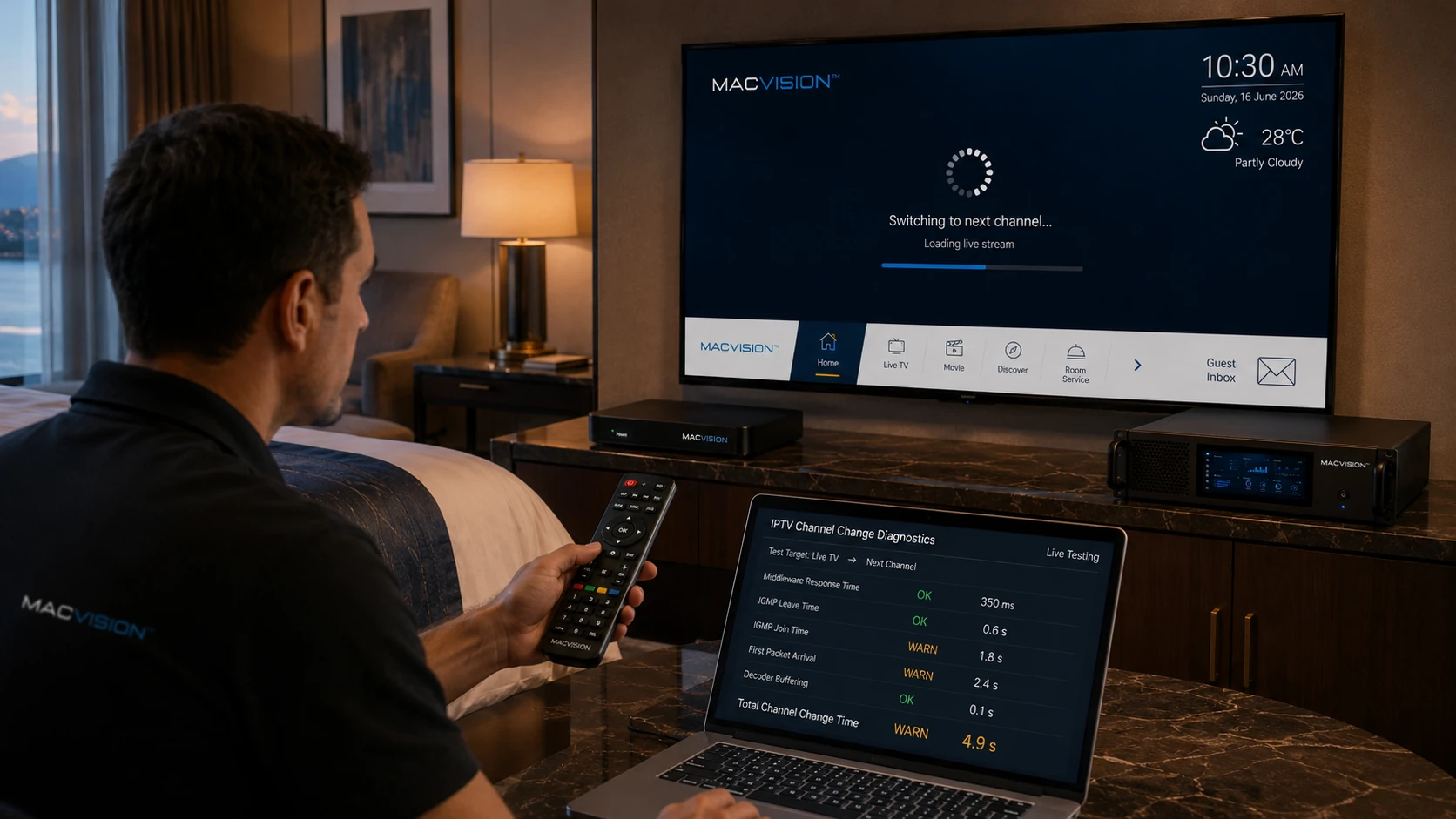
Channel-change time includes user-interface response, middleware authorization, multicast leave and join, arrival of the new stream, decoder initialization, keyframe wait and buffer fill. A delay can be created by any one of these stages. Optimizing only the network may have little effect when the encoder uses a long GOP, while shortening the GOP without measuring bitrate can increase bandwidth. Each stage should be timed separately.
Why does a TV wait several seconds before showing the next IPTV channel?
Answer: The TV may join the group immediately but wait for an I-frame before decoding. Alternatively, middleware can delay returning the stream address or the switch can take time to update group membership. Packet capture shows when the selection request, IGMP join and first media packets occur; encoder analysis shows when the next keyframe arrives. This timeline identifies the dominant delay.
How does GOP length affect IPTV channel-change speed?
Answer: A decoder usually needs a clean intra-coded frame to start. With a long GOP, the viewer may wait until the next I-frame even though packets are arriving. Shortening the GOP improves startup but increases bitrate or reduces compression efficiency. Choose a balanced interval based on target switching time, network capacity and picture quality, and keep encoder timing consistent across the lineup.
What is a realistic channel-switch optimization process?
Answer: Measure baseline time on each endpoint type, separate UI, server, join, keyframe and buffer delays, then change one parameter at a time. Optimize middleware response and database queries, correct IGMP fast-leave where appropriate, tune GOP and use a reasonable endpoint buffer. Test rapid sequential changes and return to the previous channel. Ensure optimization does not create packet loss, visible quality reduction or multicast leakage.