

MAIN TECHNICAL ARTICLE
STBs vary in decoder silicon, deinterlacing, scaling, Ethernet drivers, output color settings and firmware. Two boxes receiving the same packets can therefore produce different sharpness, motion, lip sync or stability. Low-cost devices may support a codec in principle but fail at high bitrate or complex profiles. Model selection should be based on sustained channel testing rather than menu specifications.
Why does one STB show smoother sports video than another?
Answer: The better unit may have higher-quality deinterlacing, frame-rate matching and motion handling. The other may convert 50 Hz content to 60 Hz or use simple field processing, creating judder and combing. Compare HDMI output rate, decoder settings and the display's information screen. Set the STB to match the regional source rate and test with fast motion before judging only static image sharpness.
Can Ethernet chipset quality affect STB picture even at the same link speed?
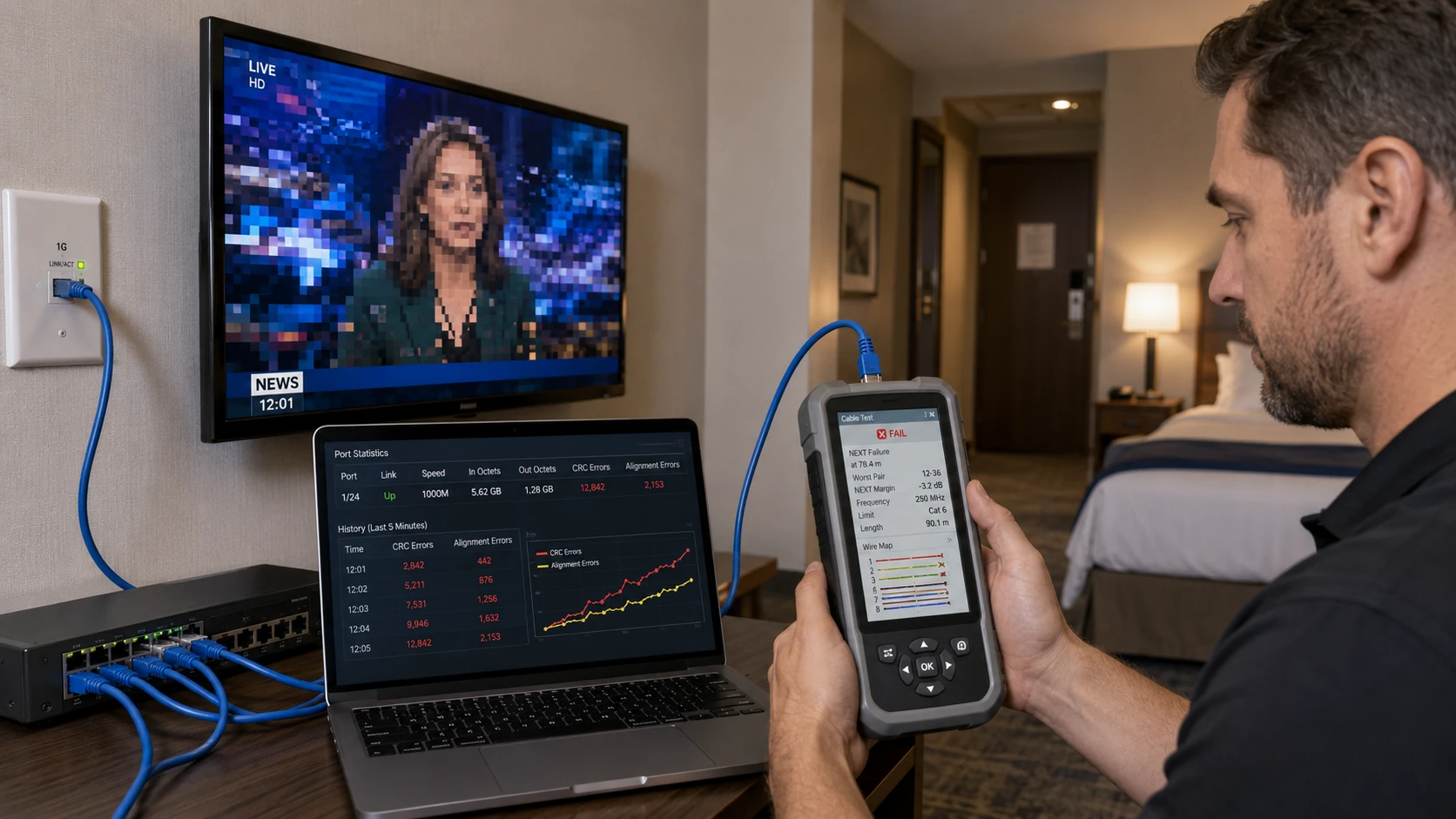
Answer: Yes. Driver stability, buffering, interrupt handling and multicast filtering affect packet delivery. Two 100 Mbps ports can behave differently under bursts or many group changes. Monitor packet loss and interface errors at the switch and device. A clean network with loss appearing only at one model indicates endpoint hardware or firmware. USB Ethernet adapters should also be tested rather than assumed equivalent.
How should an STB be qualified for a hospitality IPTV project?
Answer: Test every required codec, bitrate, audio format, subtitle, multicast behavior, channel switching, EPG, remote keys, HDMI resolution, CEC, standby, reboot and long-duration playback. Include high-temperature room conditions and simultaneous deployment load. Verify commercial support, firmware control and supply continuity. Approve the exact hardware revision because manufacturers can change internal components under the same retail name.