

MAIN TECHNICAL ARTICLE
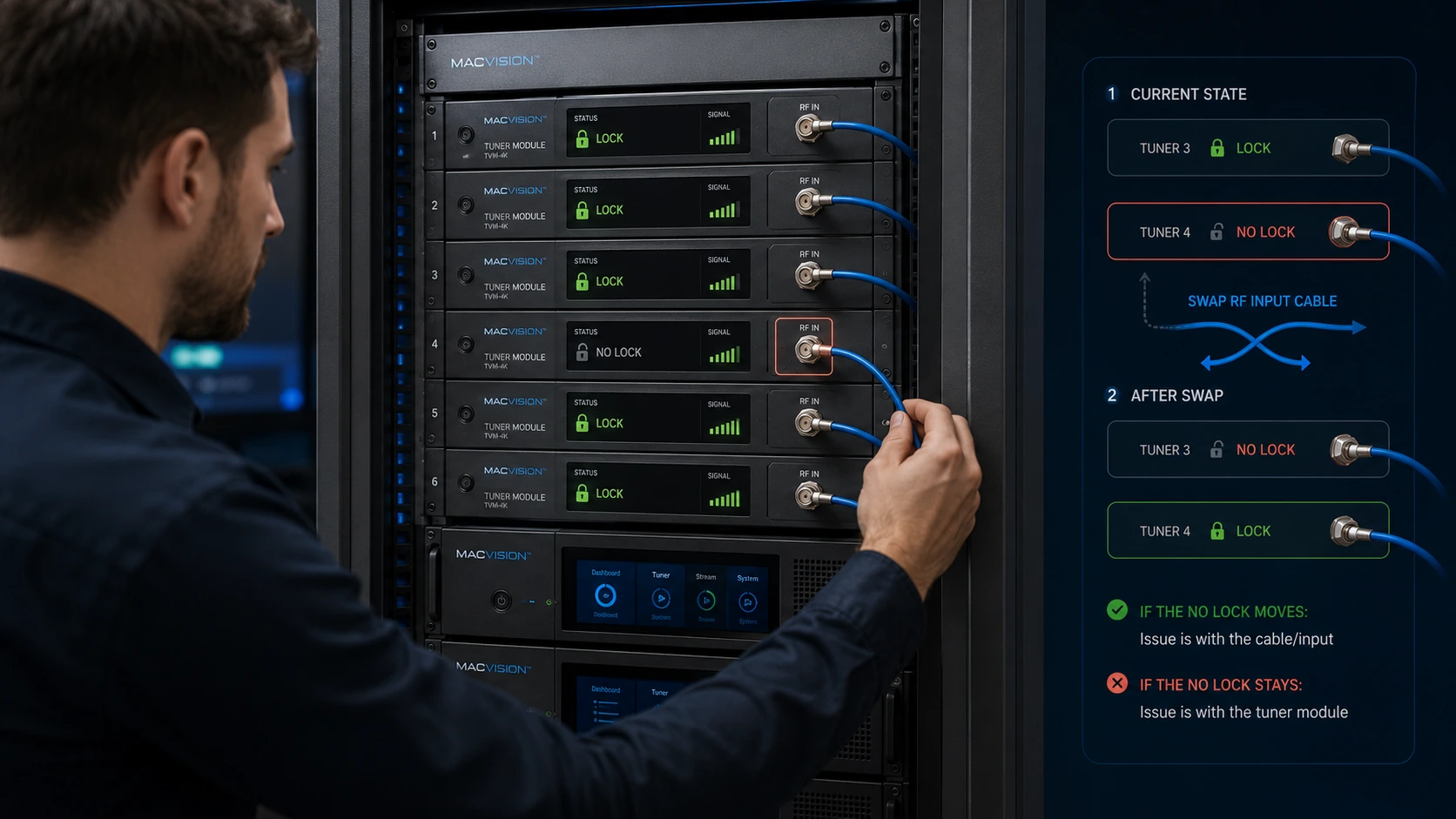
Multi-tuner IPTV gateways often share the same dish and RF distribution, yet individual tuner modules can behave differently because of port faults, level variations, firmware, resource assignment or configuration. The key diagnostic step is to determine whether the problem follows the RF cable, the physical tuner, the configured transponder or the software slot. Controlled swapping identifies the boundary without changing several variables simultaneously.
Why can one tuner fail to lock a transponder that another tuner receives correctly?
Answer: The failing tuner may have a damaged RF input, different LNB power settings, an incorrect local-oscillator profile or outdated firmware. It may also receive a different signal level because of multiswitch output variation or cable loss. In modular systems, the tuner could be assigned to an incompatible input or already committed to another transponder. Compare the complete configuration and move only the RF feed or only the tuner assignment in separate tests. The fault follows whichever element is defective.
What swap test best separates a tuner fault from an RF distribution fault?
Answer: Tune two identical modules to the same reference transponder. Exchange their coaxial inputs without changing software settings. If the failure moves with the cable, investigate the cable or multiswitch port. If it remains with the tuner, move the service to another tuner slot or replace the module. Record RF level and quality before each change. This method is more reliable than rescanning because a rescan can alter service mappings and hide the original cause.
How should inconsistent tuner performance be prevented in a large IPTV headend?
Answer: Standardize firmware and configuration templates, maintain input levels within the specified range and keep spare tuner capacity for comparison testing. Label every RF path and monitor lock state, BER and continuity errors per tuner. Avoid assigning too many encrypted or high-bitrate services to one module if the platform has processing limits. During commissioning, test each tuner on reference transponders from every required band and polarization, then save a baseline report that can be compared after maintenance or expansion.